

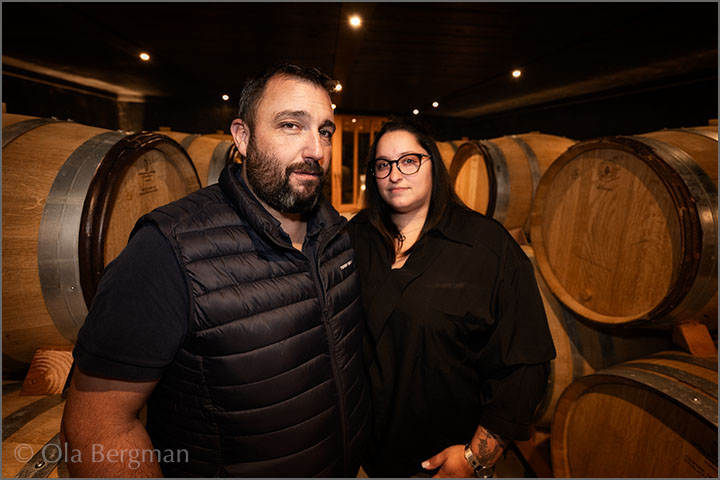
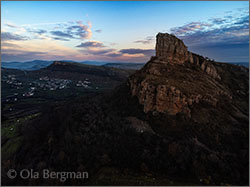
omaine Pierre Desroches is heavy on Pouilly-Fuissé. Very heavy. Roughly three quarters of the domaine’s vineyards are in Pouilly-Fuissé, around the mighty Solutré rock, producing both village appellation cuvées and premier crus.
– I was always out with my father and my grandfather when they were working, says Pierre Desroches. So the career choice was easy. I never wanted to do anything else. I went to wine school and got my BTS. I did an internship in the Luberon and was later employed for some years.
The domaine Pierre Desroches runs today together with Mélanie Blondeau is a relatively new creation. There were vineyards in the family that both his father and grandfather worked, but in terms of surface area it was modest.
– My first harvest was 2006, he says. But it was small when I started. Just three hectares.
 Since then the domaine has grown to cover close to 13 hectares.
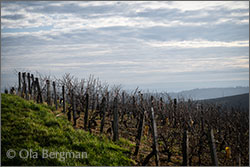
– My father only sold in bulk to the negotiants, says Pierre Desroches. He never bottled anything. The vineyards were farmed in a traditional way. It was the 1980s and the 1990s. I lost my father in 2010 and it was around that time my attention turned towards more environmental practices. It was very much a personal choice. We are the ones who use these products in the vineyards. So it’s about our health. Then there is also the environmental aspect. And the fact that the quality of the wine benefits. After some years I decided to go for certification. We started in 2018 and were certified in 2022. We fought difficult years such as 2024 and 2025. It was tough, but we stood firm. There were times when I wanted to throw in the towel, but in the end it worked out.
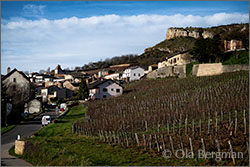
 Domaine Pierre Desroches recently moved to brand new premises in Solutré-Pouilly, at the bottom of the village where you have domaines such as Trouillet, Cheveau and Renaud nicely lined up. Before the move the bottle cellar was located at the top of the village, close to the rock, with working conditions far from ideal. Trucks could not access the place, so deliveries to and from the cellar had to be done with the forklift, while the truck was parked in the village square, blocking all traffic.
– And for the vinification we had a cellar in Vergisson. Yes, it was complicated, sighs Pierre Desroches.
 Since this is the heart of the Mâconnais there is only white wine at the domaine. There is one regional appellation wine, the Mâcon-Solutré-Pouilly.
– Our Mâcon-Solutré-Pouilly vineyard comes from the foot of the Solutré rock. Next to the parking. There is quite a lot of limestone and clay. You have fallen rocks from the Solutré rock. It’s a typical Mâcon wine, with a bit more acidity. That is the character of Solutré that comes into play. You have a nice freshness, coupled with the fruit of the Mâconnais. Some of these vines were planted in 2007. The rest are about 30 years old.
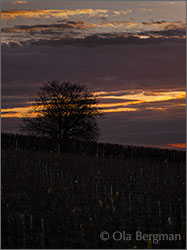 This Solutré character, this minerality, is something Pierre Desroches comes back to all the time when he talks about the domaine’s wines. It is something that helps balance the wines.
– It has kind of become our hallmark, that fact that we harvest later. Not late, but we like to push the maturity a bit in order to have this nice richness which is associated with the Mâconnais. With the minerality and freshness of Solutré you avoid creating something too heavy.
The Mâcon-Solutré-Pouilly sees no oak, and the same thing goes for the first Saint-Véran cuvée. It is all stainless steel tanks. For the rest of the wines élevage is in barrels, 500 litres or traditionally sized 220 litre barrels.
Domaine Pierre Desroches produces two Saint-Véran cuvées. The two vineyards are far apart and Pierre Desroches describes them as two extremes of what the appellation can produce.
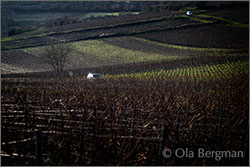 – The first one is from the southern end of the appellation, near Leynes, he says. Compared with Solutré there is a different kind of soil there. More clay than in our Solutre vineyards. The wine is rounder, more plump. It is one single plot that I planted when I started in 2006. The lieu-dit is La Combe, even if we don’t put it on the label. You have lots of clay rich in iron. Very red clay. But almost only clay, very few stones. For this cuvée we only use stainless steel tanks.
– The other Saint-Véran, Les Pommards, is from Davayé. It is at the foot of the Solutré rock, to the northeast, and here you have more of that minerality again. Élevage is in 500 litre barrels. In Les Pommards you have lots white stones. The vineyard is steeper and higher up on the slope.
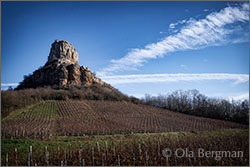 For Pouilly-Fuissé there are five different cuvées at Domaine Pierre Desroches. Two village appellation bottlings and three premier crus. There are a few more premier crus, but they are not being bottled by the domaine at the moment.
The generic Pouilly-Fuissé is the big cuvée at the domaine. It is producerad from several plots around Solutré.
– Élevage is in both 220 litre and 500 litre barrels, says Pierre Desroches. We use very little new oak. We only buy three barrels per year. The oaky character is not something we are looking for.
– The vineyards are all on the Solutré clay/limestone soil, but each plot has a slightly different character. There are parcels facing north, south, east… Mid-slope, top of the slope… Old vines, young vines.. It is really a mix of everything. Altogether it is a wine very typical of Solutré.
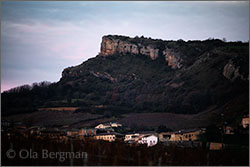 The second village appellation Pouilly-Fuissé is a single vineyard cuvée. The lieu-dit is En Charmont, which is east of the Solutré rock.
– It’s facing straight south, says Pierre Desroches. It’s a very stony slope, surrounded by a stone wall. It produces a wine with a very nice balance between minerality and fruit. Since it’s south facing you get a good maturity. Élevage is in 500 litre barrels. This vineyard is above the premier cru Au Vignerais.
With its 757 hectares the Pouilly-Fuissé appellation is substantial. It is stretched out over four communes – Fuissé, Solutré-Pouilly, Vergisson and Chaintré. Since 2020 this also includes 22 premier crus. The three premier crus of Domaine Pierre Desroches are all very close to Solutré.
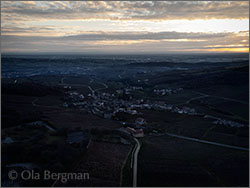 Au Vignerais, with vines between 60 and 70 years old, is just northeast of the village. En Servy is on the same side, but even closer to the village. Just as you exit Solutré to the east you have En Servy on your left.
– It’s a premier cru which is not very large. There is slightly more clay than in Au Vignerais. It’s more about richness, power and roundness. We have three plots in En Servy. One which is 80 years old, the others around 60.
Le Clos de Solutré, the third premier cru, is equally close. You come across it as you exit the village in the other direction.
– It always has good power and maturity. But it requires more time to open up. Au Vignerais with its white stones is mineral. En Servy, with a bit more clay, has a fatter character, with fruit and flowers aromas. Le Clos de Solutré is facing straight south and you get good maturity and richness.
Everything is harvested by hand at Domaine Pierre Desroches. And the switch to organic is not anything they regret, even if it has been a struggle at times.
– I’m happy with the results, says Pierre Desroches. The wines are always balanced now. We rarely have problems with too much acidity.
© 2026 Ola Bergman