
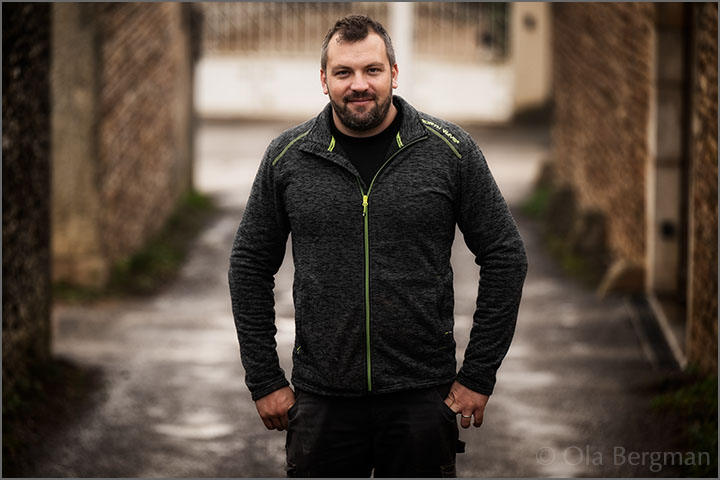
ouilly-Fuissé has changed. The development of vineyard-specific cuvées. The arrival of the premier crus. The move towards domaine-bottled wines. Guillaume Renaud at Domaine Pascal Renaud in Solutré-Pouilly has seen this firsthand. His family has been producing wine here for the past century.
– The premier crus have changed a lot for us, he says. They came at a time when the wines of the Côte de Beaune and the Côte de Nuits had become too expensive. Our premier crus are less expensive and are slowly taking the place of Meursault, Chassagne-Montrachet and Puligny-Montrachet. We were not considered as part of Burgundy before, we were the Mâconnais. Now with the premier crus our wines are Burgundy wines. People had a hard time wrapping their heads around it before. There were no premier crus, but the names of the climats, the vineyards, were on the labels. This has put the spotlight on the appellation. Since the premier crus were introduced we have changed about half of our clients.
 Guillaume Renaud is the fifth generation at Domaine Pascal Renaud. Over the years the domaine has grown, the ways of working have changed and the climate has become a challenge.
When Jean Renaud started out in 1927 it was all about renting the vineyards. Today they have their own vineyards, 20 hectares in total, and the wine is no longer sold off in bulk.
– It was my dad who began bottling in 1987, says Guillaume Renaud. My grandfather died in 1977, when my dad was only 13 years old. He had seen the négociants coming to the cellar buying wine. My grandparents could not make a living from the wine. My dad wanted to be able to live off what he produced so they began bottling in 1987. Now we have been bottling everything we produce for the past 20 years.
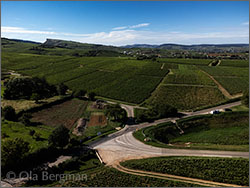 You’ll find the majority of their vineyards, 14 hectares, around Solutré-Pouilly. The remaining six hectares are in Charnay-lès-Mâcon, just next to the city of Mâcon. One of the vineyards there is the Clos de la Tournache, a monopole which has been in the family for three decades.
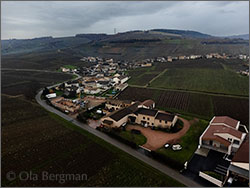
– From our perspective it’s a bit off, says Guillaume Renaud. It’s five-six kilometres from here. There used to be a lot of vineyards there. It is like a circle overlooking Mâcon and everybody wants to live there, so many new houses have been built. Land prices have gone up and there are very few vineyards left now.
– With many building surrounding the vineyard you have to be very careful when it comes to the maturity of the grapes. Because of the buildings the grapes ripen very quickly. The walls prevent the wind from reaching the vineyard and the walls reflect the heat. One has to be careful. Once the chardonnay is a little bit overripe things become complicated, the wine will be less suited for keeping. But still, the vineyard produce a very good wine. The vines are more than 80 years old. The clos covers two hectares and my parent live just in front of it. The soil is clay and marl, it is difficult to plough.
 In the past all the grapes from the Charnay-lès-Mâcon vineyards used to be blended into one single cuvée of the regional appellation Mâcon-Charnay-lès-Mâcon, with no mention of lieu-dit. Since then the Clos de la Tournache has been singled out, as well as La Vigne Blanche.
– Clos de la Tournache is mid-slope. La Vigne Blanche is higher up, just 100 metres, and there is much more limestone there. As it happens it carries the same name as one of the Pouilly-Fuissé premier crus, Les Vignes Blanches, and it is next to the Chemin de Beauregard. You have a splendid view from up there. The wind creates a nice air flow. There is lots of limestone gravel.
 – At the domaine the Clos de la Tournache is the only vineyard with that type of soil, says Guillaune Renaud. The rest is limestone. With limestone, once you have a little bit of sun the vines become thirsty. So in Pouilly-Fuissé we have been using grass to cover the soil for the past five years. We have been doing tests with half the parcels covered and we have had good results.
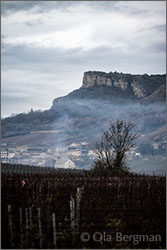
Domaine Pascal Renaud produces a regional appellation cuvée from Solutré-Pouily as well, a Mâcon-Solutré-Pouilly. It comes from a vineyard opposite the famous Roche de Solutré, the Rock of Solutré.
– It is up on Mont de Pouilly, which makes a big difference to the Mâcon-Charnay, says Guillaume Renaud. It’s the same type of soil as you have near the Roche de Solutré and the Roche de Vergisson and it is the same exposure. But the vines are young, so it makes a very good Mâcon.
Domaine Pascal Renaud is very much a family affair. Guillaume Renaud joined his parents, Pascal and Mireille, in 2009. His sister Amandine and his wife Flore complete the team.
 – Our family hasn’t owned vineyards for very long, he says. My great-grandparents and my grandparents rented vineyards from the family of Édouard Balladur, the politician. In 1987 he and his wife decided to sell the vineyards to our parents. Since they didn’t know if that ever would happen they had already bought the vineyards in Charnay-lès-Mâcon.
When it comes to village appellation vineyards the main part can be found in Pouilly-Fussé. There is one parcel in nearby Saint-Véran, one hectare in Champs de Perdrix on the Chasselas side of Saint-Véran.
Prior to Guillaume Renaud’s arrival at the domaine there were only two Pouilly-Fuissé cuvées here. The Vieilles Vignes, the old vines cuvée, and Les Chailloux, which since then has been promoted to premier cru, were the only ones. The Vieilles Vignes is still in the portfolio, but is now accompanied by five premier crus – Les Chailloux, Vers Cras, Les Ménétrières, Aux Bouthières and Pouilly.
– Apart from Les Chailloux everything went into the Vieilles Vignes, says Guillaume Renaud. That cuvée was enormous. At the time there was no talk about climats, the separate vineyards. The Vieilles Vignes comes from the bottom of Pouilly. All 15 parcels are at least 65 years old. Élevage is in foudres, large wooden tanks, or demi-muids, 500-litre barrels.
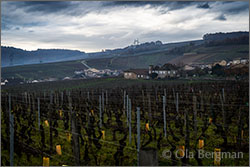 – We have increased our holdings in Les Chailloux, he continues. In 2021 we took on half a hectare which was planted during the First World War. It was a super opportunity. So now we are basically only two owners in Les Chailloux, it is us and William Trouillet.
– In Les Chailloux you have the top part, the mid-slope and the bottom part. The bottom part is slightly less good. All the gravel has ended up there and it is more productive, so this part has been excluded from the premier cru. In the past it wasn’t planted since it was prone to frost.
In Les Chailloux you have clay with chailles, large round stones, which keep the heat. In Vers Cras, where they have two plots next to the Château de Beauregard, there are large slabs of limestone and very little soil. When the weather is hot this becomes problematic with rising soil temperatures and shortage of water. This is one of the places where they have experimented with grass between the rows in order to have less evaporation.
 – Aux Bouthières is the extension of Les Chailloux, says Guillaume Renaud. We are the domaine that has the largest part of Aux Bouthières. We have several parcels. The bottom part of Aux Bouthières is not premier cru. The premier cru is very good, but there are parts which are too deep and not very good. The top and middle produce completely different wines. For the parcels we use for the premier cru the vines are more than 100 years old. When my family arrived here they were already planted. It has never been uprooted and replanted. About 25 years ago many growers uprooted, but luckily my parents couldn’t afford to do that. The old vines are resistent to both drought and humidity. They are sélection massale. They produce less, but regularly. Young vines can produce a lot one year, and not the next.
Les Ménétrières is located in Fuissé. It is one best parts of Fuissé according to Guillaume Renaud.
– It is the extension of Les Vignes Blanches, he says. It’s the flagship of Domaine Ferret. It is approachable when young. For all our premier crus demi-muids are used for the élevage. We use new oak for the Pouilly and Aux Bouthières. It is usually for 24 months. Then we move them to stainless steel tanks before bottling. Over the years we have been experimenting, so we have arrived at what each cuvée needs. Also, depending on the vintage, if it has been hot or not, we change the élevage.
Guillaume Renaud points out that their father is getting close to having worked 50 vintages, which is a wealth of experience.
– Our grandfather used to make notes in a calendar, everything was done during the winemaking process. I use it whenever I need information. It is part of the domaine. If you want to move forward you can’t forget the past. My sister is passionate about horses. She owns a Friesian and she wants to use a horse to plough the vineyards. When the vineyard tractors arrived our grandfather did not want one. Eventually he was the only one to use a horse around here.
© 2026 Ola Bergman