
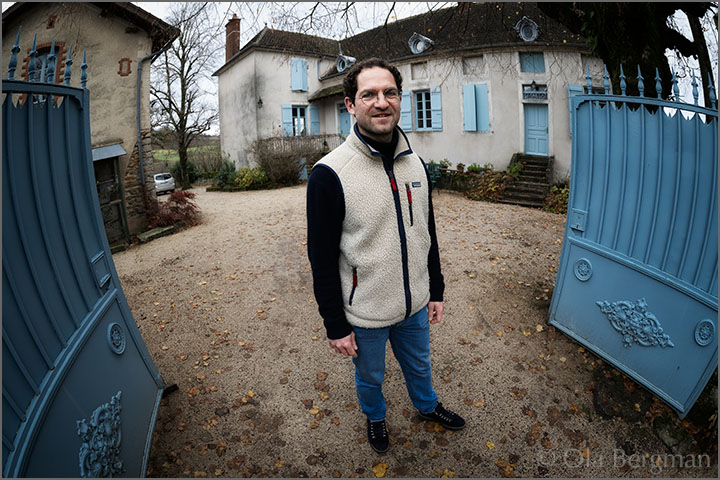
here was a time when Domaine du Chétif Quart was tiny. Less than one hectare. That was in 1979. Since then the domaine has grown, but it has also been saved twice. And in the early days they caused a bit of a stir when they chose to go the organic route.
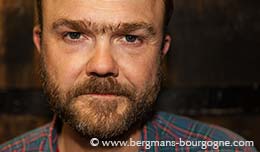
– Organically is the way we work, says Lucas d’Heilly. We don’t know how to do it in any other way. It is all thanks to my parents, who were regarded as a bit odd by the locals when they didn’t want to use the available products back in the day.
Lucas d’Heilly arrived at the family domaine in 2019. By then his parents – Martine and Pierre – had taken on more vineyards and started crémant production together with Guy Chaumont, who, together with his father, pioneered in organic wine growing. Being located in Cercot, one of the hamlets surrounding Moroges, Domaine du Chétif Quart is in the middle of the Côte Chalonnaise, just a ten-minute drive from Givry.
 Initially the domaine was called Domaine d’Heilly-Huberdeau, a combination of the parents’ last names. In 2020 it was changed to the current name, a name taken from a lieu-dit just behind the domaine. The wine portfolio grew from just Bourgogne Passetoutgrain to include Bourgogne Aligoté, Bourgogne Côte Chalonnaise, Givry premier cru and crémant.
– My grandfather passed away too young and it was difficult for my grandmother to have both a house in Versailles (outside Paris, 360 km from Cercot) and one here Cercot, explains Lucas d’Heilly. In order to save the domaine my father and his brother and sister all moved here. Each of them had their own house. They wanted to be here in order to be able to maintain the property, to be able to keep it in the family.
 Once in Cercot the question about producing wine came up. The equipment was still there and the 80 ares of vineyard were let to a local grower, who agreed to return it to the family.
– My grandfather was an engineer at Nestlé, says Lucas d’Heilly. He worked a bit for Peugeot as well. He completely abandoned the viticulture. My great-grandfather on the other hand lived here and was a négociant, so the cellars were used already back then. And like most others at the time it was not only wine. Polyculture was the norm. Winegrowers would grow other crops as well and keep animals.
– Moroges has 600 inhabitants, he continues. There are several hamlets. Cercot has historically been the most wine-focused part of Moroges. Before 2000 there were about ten winegrowers here. In 2000 there was a crisis when the négotiants would not buy any wine for two years. As a result five or six growers had to give up their business.
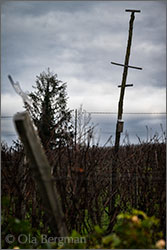
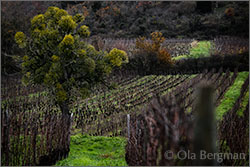 You’ll find a large part of the Domaine du Chétif Quart vineyards right behind the winery, up on the Mont Avril slope. This is the case with the aligoté, Les Molottes.
– Les Molottes is a lieu-dit just next to Chétif Quart, says Lucas d’Heilly. We have 50 ares of aligoté there. The élevage is part barrel, 30 to 40 per cent, but no new oak, part stainless steel tank. This is to keep the freshness. In total the élevage is ten to twelve months.
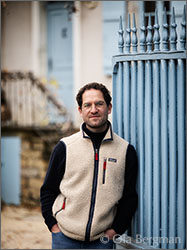
Lucas d’Heilly arriving in Cercot in 2019 meant that the family domaine was saved for a second time. What his parents had created could live on for another generation. But it also meant that, in a twisted way, polyculture was back. Or at least a man wearing two hats.
– Yes, I do wear two hats, he smiles. I am also a GP, general practitioner. I did my first six years in Dijon, then another four years at Paris Descartes University. Because when I was 18 years old I didn’t exactly fancy the winemaking world. I found it tough and unrewarding. As a winegrower you have difficult years, a few better years, then some less good years again.
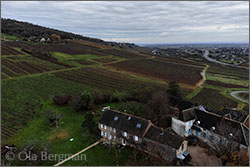 While studying medicine it slowly dawned upon him that there were some upsides to being a winegrower. He also asked himself if he was prepared to sell that part of his past. Eventually he bought the house, the house where he was born. As he puts it himself, he left happy, but returned happier.
– I decided not to choose one career over the other, he says. During my studies I told my parents I might take on the domaine. They told me to finish my studies first and then we would decide. They were right, and also, I love the medicin. Initially I was not planning to do both, but gradually I realised it would be possible. Now I work at the domaine until one or two in the afternoon Monday to Thursday. Afternoons and one Saturday morning per month I’m at the surgery.
The Bourgogne Côte Chalonnaise comes in three different versions at Domaine du Chétif Quart. One white and two red.
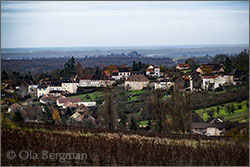 – The white cuvée is La Cour aux Étoiles. It is blend of two parcels, just behind here. The main parcel is 30 years old. It is mid-slope. Élevage is the same as for the aligoté. La Cour aux Étoiles is a place on Mont Avril. Just a few hundred metres further up. You can find star shaped fossils there.
– For 20 years there was only the aligoté and the Givry premier cru in white. I wanted a wine that could fit in between the two. That’s where the La Cour aux Étoiles came in. Especially since the Bourgogne Côte Chalonnaise appellation is our main thing. The appellation was created in 1990, but not everyone puts it on the label. Some still put just Bourgogne.
 Even if his parents didn’t have much land for wine production when they started out in 1979 they still had some land better suited for other purposes. They used these plots in exchange for vineyards up on the slope. So step by step the domaine grew to cover five hectares. At one point, around 2004, they even had seven hectares, but they felt it was too much.
Along the way they acquired a small part of Givry premier cru Le Paradis. This lieu-dit immediately southwest of the village is mainly village appellation, but a small part, about a tenth of the whole thing, is classified as premier cru. At Domaine du Chétif Quart it is produced in a similar way as the other whites. Stainless steel tanks are used for close to 40 per cent. For the part in barrels ten per cent new oak is used.
– Le Paradis in Givry has quite deep soil. It is rich soil which comes from the hill further up. Above Le Paradis you have La Baraude and other nice clos. We are at the bottom of the slope. It produces whites with power and character.
 – My parents didn’t use barrels during élevage, because they felt there wasn’t a need for it. We still drink the old vintages that didn’t see any oak and they are very good. I am using barrels since I want to add a little bit of complexity, nothing too obvious.
Lucas d’Heilly feels that five hectares is the optimum size. It is manageable and still possible to maintain quality. The only thing he is missing is a village appellation red, something which is on its way. He has found a small plot in the village appellation part of Givry, Le Paradis, which will be planted with pinot noir.
– I want to maintain the quality level my parents set. And I want to improve what I can improve.
– I’m happy that the wines come from vines planted by the domaine. The choice of clones etc has been made by us. The land has been worked by us, in our way. I think it is a bonus to have that knowledge. Of course you can take on vineyards from others, vineyards that have been well-maintained. But I think it is nice to have this history of the vineyards, how they have developed and now reached a respectable age. I’m lucky to be working with vineyards which are now 40-50 years old.
 The two red cuvées of Bourgogne Côte Chalonnaise – Les Passereaux and Le Quart Chapeau – both come from the vineyards up behind the doamine.
– Les Passereaux is all about doing something with the freshness and the generosity of the pinot noir, its silkiness. Éleveage is part barrel, part tank. Roughly 50-50. Just five to ten per cent new oak. The average age of the vines is 40 years.
– The lieu-dit is called En Passerot, and there is a parcel in Chétif Quart as well. So we named the cuvée Les Passereaux (passerine birds). Those are the kind of birds you find in the garden, everywhere basically. My father has always been passionate about birds. In the vineyards there are many birdhouses. Probably about 50 that my father maintains every year.
– Le Quart Chapeau is kind of the pride of the domaine, because it’s a wine which my parents isolated from the ordinary Bourgogne Côte Chalonnaise cuvée back in 2001. There is more work with green harvesting etc. It’s mid-slope, with high quality clones. It’s a wine which has more opulence and richness. The élevage for Les Passereaux is twelve months. Le Quart Chapeau stays in barrels for 15 months, sometimes more, sometimes less. The élevage is longer, but the wine can take it. It is 100 per cent élevage in barrels. Ten per cent new oak, not more.
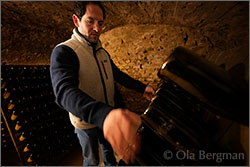
Domaine du Chétif Quart is unusual in the sense that it produces its own crémant, not like majority of domaines in Burgundy who leave part of the process to companies specialised in bubbles.
– My parents started making crémant in 1995, says Lucas d’Heilly. They did their training in Champagne and that is where they found the necessary equipment there as well. They set up their own thing mainly because there weren’t any producers of crémant who would take on a small organic cuvée. Most is produced from many different base wines and domaines. The domaines receives the bottles to put their own labels on, but it is not necessarily their own wine. The wines are often good, no judgement there, but if you want to produce your own organic cuvée it is difficult.
© 2026 Ola Bergman