

he Hautes-Côtes is booming. What was once an anonymous part of Burgundy is now a vibrant community with many young winegrowers with new ideas. Domaine Nicolas in Nolay is no different. The new generation has taken on the family domaine and moved things one step further.
– It started to change 15 years ago, says Mylène Nicolas. Selling the Hautes-Côtes wines has become much easier. We offer a good price-quality ratio. With the high prices in the Cote d’Or people have started to look elsewhere. And you have many young growers who are starting out here. They are bottling their own wine. In the Hautes-Côtes bottling is something that has been done for just one or two generations.
 She and her brother Benoit are in the tasting room of Domaine Nicolas. The domaine is up on the slope on the outskirts of Nolay. The view from here is stunning.
– You have Beaune over there, Chalon-sur-Saône over there and Autun in that direction, says Benoit describing the location of the winery. We are right in the middle of the three. And when the weather is good you can see Mont Blanc from here.
– We took on the domaine in 2019, he continues. I started working here in 2017 and my sister in 2015. It was our grandfather and our great-grandfather who started planting vines. Our father retired in 2024
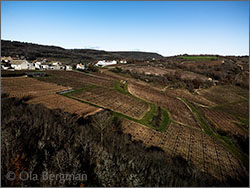 Today’s Domaine Nicolas covers 20 hectares. The majority of the vineyards, 16 hectares, are in the Bourgogne Hautes-Côtes de Beaune appellation. Most of it is pinot noir, with a little bit of chardonnay thrown in for good measure. In addition to that there are vineyards in Saint-Romain, Santenay and Pommard.
The Hautes-Côtes de Beaune appellation saw the light of day 1961. Just before that, in 1956, Bernard Nicolas arrived at the domaine. At the time it was a mix of vineyards, cereals and cows. Later on, in the 1970s, he would transform it to the wine only business his grandchildren run today.
– Since we are close to Autun and Le Creusot, the mining district, it used to be a lot of gamay in the past. With all the people working there was a big demand for wine. When the appellation for the Hautes-Côtes and the cooperative, the Cave des Hautes-Côtes, were created things changed.
Their father, Alain Nicolas, joined his father in 1985 and it was he who in 1992 decided to stop working with the cooperative and start bottling part of the production himself.
 – Our dad always used quite modern equipment, says Mylène Nicolas. We have continued buying new equipment.
– We change a little every year, says Benoit Nicolas. Small steps. One big change is the commercial side thanks to my sister. Our dad sold a lot in bulk. For our grandfather it was just vineyards, no wine. Our dad started bottling, but did not have the resources to go all the way.
There are a lot of old vines at Domaine Nicolas. A large portion of the vineyards are between 40 and 60 years old. Of the total output 80 per cent is red. And with the arrival of Mylène and Benoit much more is being bottled at the domaine and more vineyards have been added.
 – We use barrels for all our wines, says Benoit Nicolas. The white Hautes-Côtes de Beaune comes from three parcels here in Nolay. It’s a mix of young and old vines, with the oldest being 60 years. Fermentation takes place in barrel. All wines are made in the same way. What makes the difference is the terroir, and a little bit of tweaking the élevage. The amount of new oak varies and you don’t have the exact same barrels.
In 2023 they added vineyards from their grandmother – Saint-Romain, Sous Roche (white), Saint-Romain, Sous la Velle (red) and Pommard, En Boeuf. Back in 2005 the other white Saint-Romain, En Chevrot. The Sous Roche 60 years old and En Chevrot 40 years.
– En Chevrot, which is the end of the valley (in front of the upper part of the village), says Benoit Nicolas. Sous Roche is really close to the bedrock. Very little soil, stony. En Chevrot has deeper soil. Sous Roche is more mineral, tighter. En Chevrot is fatter, more plump.
The red Hautes-Côtes de Beaune is split into three different bottlings. The main cuvée is the Vieilles Vignes, the old vines cuvée.
 – It is a blend from several parcels, which are at least 50 years old, says Mylène Nicolas. They were planted by our grandfather and our great-grandfather. Barrels are used, but no new oak. We want to keep the fruit. It’s a wine which is accessible in its youth.
The other two Hautes-Côtes de Beaune bottlings are both single vineyard cuvées, En Château and Les Jarons.
– En Château is the only Hautes-Côtes de Beaune of ours which is not here in Nolay, says Mylène Nicolas. It’s seven kilometres from here, in Baubigny. It’s the same altitude. But here in Nolay the vineyards are facing straight south. En Château is facing southwest and the soil is not at all the same. The clay finer and there is more silt
 – Les Jarons is a vineyard here in Nolay, says Benoit Nicolas. A bit longer élevage, 18 months. We use 400 litre barrels. Les Jarons produces a more powerful wine. There are more tannins. It’s a wine to lay down for a long time. You have the fruit there, but it is more on the spicy side. When you use large barrels the wine evolve less quickly. They don’t round off the wines as much as smaller barrels do. And the oak is more subtle. The first vintage for this wine was 2022.
Benoit Nicolas points out that over the last decade or so it is not only a new generation of winegrowers who have brought change to the Hautes-Côtes. Climate change means that the character of the wines has changed. Today the wines have a better maturity and are more balanced.
– For us, the effects of climate change can be a problem, he says. Most of our vineyards are facing straight south, which means the growing season starts early. But when that happens there is the spring frost that might cause a lot of damage..
 – Often in April we have a touch of colder weather, says Mylène Nicolas. It will destroy the buds that have burst. But it’s the nature of the Hautes-Côtes. There used to be a week’s difference between the Côte and here. That’s no longer the case, but we still have the cold nights. And that difference in temperature can be fatal.
Domaine Nicolas is not organic. Instead they work along the principles of lutte raisonnée, a compromise between organic and traditional wine growing.
– We try our very best, says Benoit Nicolas. In 2024 in organic wine growing would have meant no harvest at all. We allow us to use chemical treatments during difficult periods. We no longer use weedkillers. We have never used insecticides or fungicides. We try to do as much organic as possible. We plough the soil. And we try to act at the best moment possible. Viticulture has changed in that manner that we are more precise today.
The vineyards in Santenay, the village appellation Les Charmes Dessous and the premier cru Grand Clos Rousseau, were bought by Alain Nicolas in his youth.
– Les Charmes Dessous is below the village, explains Benoit Nicolas. Behind the casino in Santenay. The soil is deep and the wines powerful. Both our Santenays are on the Maranges side of the appellation. In Grand Clos Rousseau there is much less soil, more stones. It is well-drained. The wine is less powerful on palate, but longer and more elegant.
© 2026 Ola Bergman