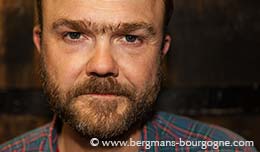

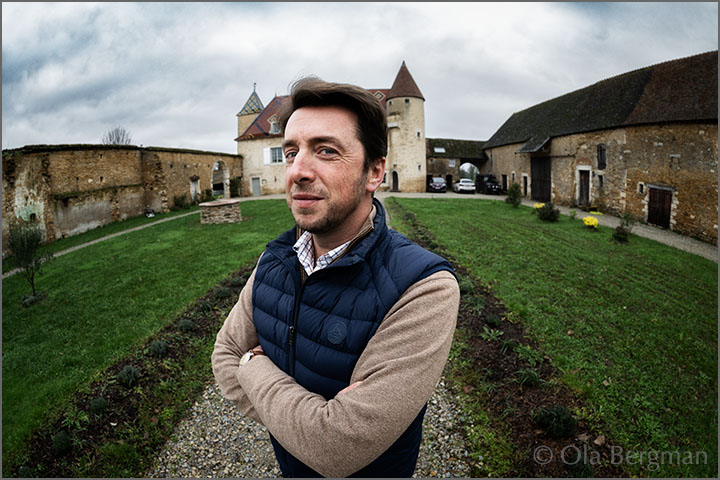
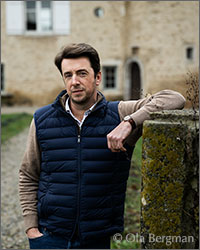
athieu Socrate started out with a plot of aligoté. A very small plot, but of respectable age, almost century old vines. That was it, his first adventure in Burgundy. That was how Domaine Socrate saw the light of day in 2021.
– The first two years I just had the aligoté, so it was basically nothing, he says. Today I have five hectares. So by now I have done three ”real” harvests.
Domaine Socrate has its roots in Burgundy, but took a detour to Paris for a number of years.
– The idea to move here goes back a long way, explains Mathieu Socrate. My wife is from Burgundy and her parents live five kilometes from here. I discovered Burgundy thanks to her. My family comes from the southwest. We met in Paris. Three of my four grandparents come from the southwest, but I grew up in Paris. You say that you live in Paris, never that you are Parisan, you always have your roots somewhere else.
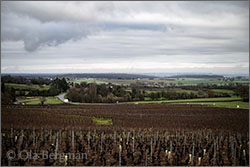 Here in this case is Granges, a small village in the Côte Chalonnaise, halfway between Givry and Buxy, with some 600 inhabitants. After having met and worked in the French capital Mathieu Socrate and his wife felt it was time to leave Paris in order to give their three children a better place to grow up.
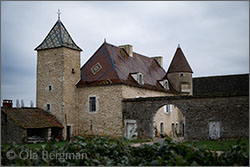
– The domaine was created in March 2021, says Mathieu Socrate. I went to wine school in Beaune in 2020 to get my diploma. We settled in here when the schools started, so that was in September 2020. This house belonged to my wife’s grandmother, but everything needed to be renovated. It is a lot of work and it is still much left. I am doing the majority of the work myself.
Already before the move they were visiting Burgundy almost every weekend. So when the moment arrived it was not a particularly difficult decision.
 – I had fallen in love with Burgundy and its wines, says Mathieu Socrate. There was a Montagny premier cru in 2008… I had never drunk a wine like that. I discovered more and more. I made friends with winegrowers and I felt it was a great thing to do for a living. Initially I was thinking about Burgundy in terms of a place to retire, with a small plot of vines. But that changed.
– In Paris I was in commercial real estate. I sold and rented offices. It had nothing to do with wine, but I loved it. I did it for more than ten years.
But there was one major obstacle when arriving in Burgundy – finding vineyards. Côte Chalonnaise is not terribly expensive. The prices are not as high as in the Côte de Beaune or the Côte de Nuits. The premier crus will of course set you back a bit, but the village and regional appellations are still affordable. But regardless of price finding vineyards that are for sale is difficult.
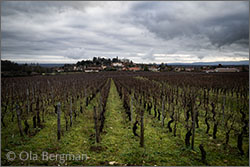 – You have to know people, says Mathieu Socrate. We’ve only been here for a few years, but my wife’s family has been here for 300 years, so we have many friends around here. I believe for anyone who doesn’t have the same roots it can be very difficult. Over two years I spoke with everyone, everywhere. And I ended up with three and half hectares.
– I even managed to get some Montagny premier cru. I have friends here who have never managed that. So I’m very happy with what I have. By now I have five hectares, and I will not go above six.
 The Montagny premier cru is Les Coères, one of the westernmost premier crus of the appellation. Together with a plot of village appellation Montagny in Les Chaux these are vineyards he took on in 2024. Les Coères is 20 ares and Les Chaux 35 ares.
– Les Chaux is in Jully-lès-Buxy. You have the road to Cluny, with the premier crus on the right side. Les Chaux is on the left side. Les Coères, Les Chaniots and the other premier crus are on one side of the road and Les Chaux is just below.
– These are two expressions of Montagny. I was already very familiar with Les Coères, because I have friends like Camille Feuillat at Domaine Feuillat-Juillot, Yann Flandre at Domaine de Montorge and Didier Charton at Domaine Charton-Vachet, who all make Les Coères. I think it is one of the best premier crus of Montagny. So I am very happy to have it.
– Les Coères is marl with very large stones, which makes it very difficult to plough. 30-40 centimetres of soil is all there is. Warm place. Facing straight east. My plot is just a few rows, but very long. 200 metres.
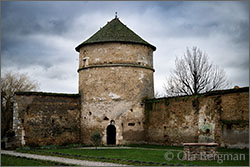 – Half of Les Chaux was replanted in 2017, so the vines are young. The other half was planted in 1962-1963. The soil is deeper. It is more silty. Super easy soil to work. Small limestones, white, almost chalky.
At this point, far from everything is bottled at the domaine. Much of the production is still micro-cuvées. Annually Domaine Socrate puts out 5 000 bottles, but the goal is 25 000. Much is sold as grapes to Sylvain Pataille.
– It was a wonderful opportunity, starting to work with Sylvain Pataille. He has been very helpful, giving me lots of advice. He’s a lovely person.
The first red wine of Domaine Socrate was the Bourgogne Côte Chalonnaise. The plot Mathieu Socrate rents is in the commune of Jambles, not very far from Givry.
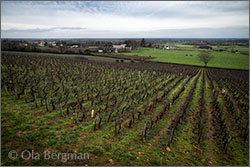 – It is called Les Clous, says Mathieu Socrate. It was planted in 1950-1951. It’s difficult to tell the difference when you look at the vines, if they are 70 years old or 40. But in terms of taste there is a difference. In 1950 there were no clones. I think the first ones came around 1965, and from the 1970s everybody was using them because they would produce more. I make about 35 hl/ha from these old vines. What you get is complexity, pure fruit, something you will not find it in the clones planted 1970s and 1980s.
– I like the Les Clous very much. It is very steep. I use a crawler tractor there, since you can’t use a enjambeur. It’s too dangerous. The soil is marl and limestone, very poor. It suffers easily from heat and it’s facing straight south. The owner is 94 years old and he has been working there all his life. He started with horse, and it was only later he got a tractor.
– He has removed two rows and planted trees in the middle of the vineyard. Cherry, almond, and apple. There are even more trees at the bottom of the plot, so what you have is an incredible diversity. The only problem is that it attracts a lot of wildlife. There are always roe deers and hares there.
 Just 300 metres from Les Clous is where you’ll find the village appellation Givry of Domaine Socrate – La Matrosse.
– It was planted in 1998, says Mathieu Socrate. So it is clones, but the terroir is more interesting. It is not the same soil as Les Clous, even if it is close in terms of distance. There is more clay. It’s facing south as well, it’s the same slope. It’s less stony. The pinot noir I have there is more productive, so I’m trying to reduce the yield. There is also a premier cru La Matrosse, just above. There are not many who put La Matrosse on the label. They probably blend it with other plots.
2026 sees two more vineyards producing grapes for Domaine Socrate. In 2024 Mathieu Socrate managed to find three hectares of vineyard land not yet planted – two in Rosey, just across the road from Granges, for white Bourgogne Côte Chalonnaise, and one in Bouzeron. These young vines are now old enough for their first harvest.
– The plot in Rosey was originally a clos, says Mathieu Socrate, Le Clos Saint Pierre. It was uprooted after the first world war. Many French died during the war, so when the war was over there was a labour shortage. Since then it just been a field for cows and horses. Nothing has been added, no treatments. This will be interesting to see how it develops, because such a thing is rare in Burgundy.
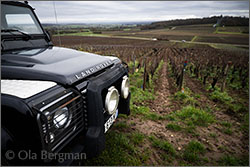 Out of the two hectares in Rosey only 55 ares were planted, but planting close to one and a half hectare in one year can still be a daunting task.
– When I look back at it I think it was a bit crazy, says Mathieu Socrate. Even if I didn’t do the planting myself, it comes with a lot of work. The young vines are fragile and they need to be protected throughout the year. In addition to that 2024 was heavily affected by disease, which complicated things. Altogether I did 15 treatments that year.
– I am certified organic since 2026. I’m thinking about trying biodynamic. First just small plots, because I’m a rational person and I need to understand what I’m doing. I don’t want to do biodynamics just for the nice photos, I need to understand what I’m doing. But it takes time.
In Bouzeron the newly planted plot is in Le Champ des Crots, which is on your right as you exit the village towards Rully and Mercurey.
– It is facing west, says Mathieu Socrate. You have two slopes in Bouzeron, one facing east and one facing west. The advantage with facing west is that you have a cooler place, since the sun reaches this part later. You have more sun later in the day than in the morning, which means it’s less sensitive to frost. The downside is the mildew. The soil is grey marl and limestone, about 75 per cent, the rest is silty clay. There is more iron oxide there. The soil is deep in Bouzeron. Even up on the slope you have a metre and a half of soil.
© 2026 Ola Bergman