
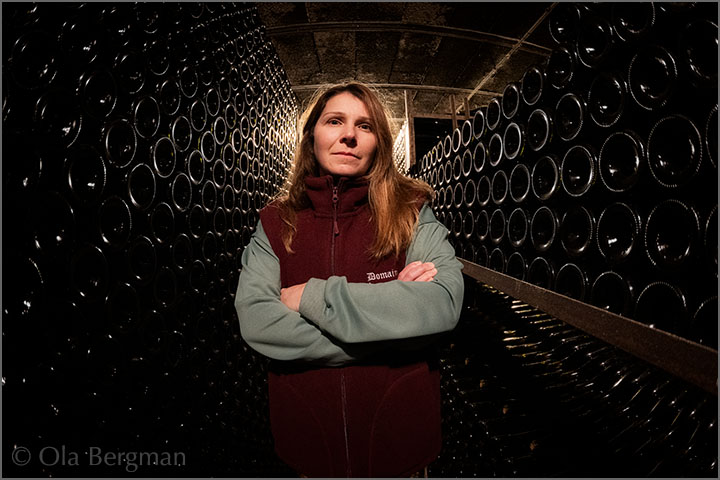
omaine Besancenot is a cross section of the Beaune vineyards. It even specialises in the northern end of the appellation. Seven premier crus, with a village appellation wine thrown in for good measure.
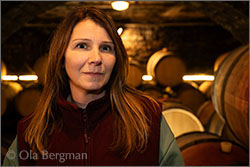
– It’s a nice heritage, says Thérèse Besancenot. We have ten hectares in total. Six of them are Beaune premier cru. People would like to be able to buy Pommard or Volnay here as well, but it has become my strength that they can’t. People come here to talk about Beaune.
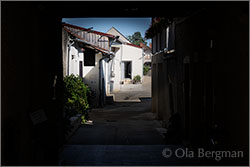
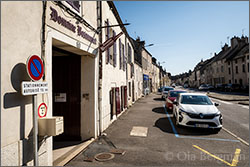
The place is the Saint-Nicolas quarters, just north of the ring road in Beaune. This was once the winegrower quarters of the town. Today there is only Domaine Besancenot left.
 – I’m the sixth generation here, she continues. The sixth generation to work the vineyards, that is, not making wine. The family had vineyards, but in the past all grapes were sold to négociants. Then, during the 1950s, things slowly began to change. Wine was made at the domaine, but it was still sold to négociants. Bottling didn’t start until the 1960s. My grandfather, who was born in 1920 and died in 1979, built the cuverie in 1955. He used to rent a cuverie close to the flower shop here in Saint-Nicolas, but he needed one of his own. At the time there were just winegrowers around here. Today I don’t sell any grapes. A small part of the production is sold to négociants, but it is wine that I make.
In terms of wine production Beaune is dominated by the big négociants. Domaines like Besancenot are rare here. Thérèse Besancenot and her brother Dominique have been running the domaine since 2011, but the history of the domaine goes back to 1850.
 – Before 2011 we were employed by our father. Beaune has always been a town of négociants, says Thérèse Besancenot. In the past there were winegrowers here, but they sold their grapes to the négociants. This neighbourhood used to be filled with winegrowers.
– Before returning to the family domaine I worked as a bank manager. Since we are three sisters and my brother the transition between the generations was done the traditional way. It’s the son who takes on the domaine.
– I will not lie. I was working at the bank and I was bored. So I decided to return to the domaine. My father and brother love the vineyards, they love the vines, but the commercial side isn’t their thing at all. So initially I said I would help them there.
But she didn’t stop there.
– I did my first vinification in 2006, and I have never looked back. I want to make the wine, because I want to sell what I have made with my hands. For me it became important to sell directly to people coming here to the domaine, to be able to tell the story behind the wine. Sales have really changed. When I arrived my dad had the equivalent of six vintages in the cellar. He didn’t want to sell. So financially it was very complicated.
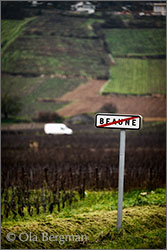
 As mentioned, you’ll find the absolute majority of the Domaine Besancenot vineyards at the northern end of the appellation, towards the Paris motorway and Savigny-lès-Beaune. In the old days, when only horses were used, proximity to the vineyards was important and the effect of that still shows in how many domaines’ portfolios are put together.
Up until 2003, when the parents divorced, Domaine Besancenot covered 15 hectares. Back then it included Pernand-Vergelesses, Aloxe-Corton and Corton-Charlemagne as well.
 – Since then we have added Bourgogne, Bourgogne Aligoté and Chorey-lès-Beaune, says Thérèse Besancenot. I have been looking into having vineyards further away, but then it becomes a whole different thing. It becomes a question of logistics and you need to be able to move your tractors over longer distances.
Despite having acquired new vineyards lately Domaine Besancenot is still very much a red domaine. Only two per cent is white.
– We have replanted part of our Beaune premier cru Cent Vignes with chardonnay. So at the moment we are the only ones to have a white Cent Vignes. We might do the same thing with another parcel in a few years time.
– Our Bourgogne Aligoté comes from a vineyard in Corgoloin. One of our father’s cousins bought it and we are taking care of it. It is 72 ares. Across the road is our Bourgogne rouge, 50 ares.
The Bourgogne blanc is a blend from two plots, one in Pommard and one in Gigny, the village immediately east of Chorey-lès- Beaune. There is also some Hautes-Côtes de Beaune from rented vineyards up on Mont Battois.
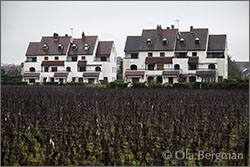 – The red Chorey-lès-Beaune and the white Chorey-lès-Beaune (lieu-dit Les Poiriers) have always been in the family, says Thérèse Besancenot. In the past there wasn’t an appellation for Chorey-lès-Beaune, it was Côte de Beaune and my father had gamay vines there. In 1989 when the appellation was created the gamay vines were uprooted. Since there wasn’t any white at the domaine it was replanted with chardonnay. Later on we have took on a plot of Chorey-lès-Beaune rouge from a friend of my father's. He died and his children did not want to continue. That plot is next to the white.
Domaine Besancenot is not certified organic. Thérèse Besancenot says they have no wish to become certified, but that they work organically. They have never used weedkillers. They have always ploughed the vineyards. Insecticides are never used and they only spray when necessary.
 Beaune is a peculiar appellation in that you have very much premier cru land and very little village appellation land. The 42 premier crus take up 75 per cent of the total surface area, leaving just 100 hectares for the village appellation.
– We rent Les Mariages, which is the only village appellation Beaune we have, says Thérèse Besancenot. It is next to the rugby stadium, below Cent Vignes and Toussaints. It is a very small plot, just 25 ares. So we are definitely missing some entry-level Beaune. I like Les Mariages a lot. It has the same Beaune character as the premier crus above. You have the rugby field in the middle, so Les Mariages is split in two parts. It is not very large. We are only three, maybe four, who produce Les Mariages. There is us, Domaine Cauvard and Domaine Jean-Claude Rateau, who labels it Clos des Mariages.
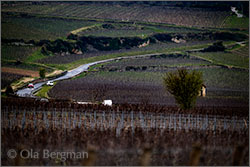 – There used to be more village appellation Beaune in the past, but the land has been used for various buildings and the hospital. It is more evident at the northern end of the appellation.
Among the premier crus of the domaine, Clos du Roi, Cent Vignes and Grèves are the oldest plots.
– My grandfather presented the Clos du Roi at the Concours Général Agricole in Paris, where he received a medal. Then later my father bought Bressandes and Theurons. À l’Ecu is tiny. 19 ares is all we have. We produce a maximum of 900 bottles annually. We are only three owners in À l’Ecu – Bouchard Père & Fils, Domaine Chanson (who have stopped bottling it separately, it is used for their Beaune premier cru blend Le Bastion instead) and us.
Thérèse Besancenot explains that she basically uses the same winemaking process for all wines, regardless of the appellation. A few days after the vinification the different terroirs will begin to shine through.
 – Clos du Roi has a lot of clay, she says. In Cent Vignes we are in the bottom part, where there is a bit more limestone, but like in Clos du Roi you have the clay as well. Theurons is very difficult to work since the bedrock is close to the surface, making replacing the posts very tricky. I hate it. Bressandes is all sand, while À l’Ecu has lots of big stones. Toussants is very much like Clos du Roi and Grèves is a mix of clay, limestone, pebbles and sand. Our part of Grèves is at the bottom, towards Bouchard’s Grèves, Vigne de l'Enfant Jésus. Grèves is always the first plot to be harvested. It is better exposed than the others.
Harvest is done by machine at Domaine Besancenot. It was not planned that way, but when the housing for the harvesters didn’t live up to the regulations in the late 1990s that was what triggered the move from harvest by hand to machine.
– 1998 was the first year, says Thérèse Besancenot. My father was against harvest machines. We had a house for the harvesters, one dormitory with bathroom for the men, and one for the women. But the law said it had to be one bathroom for six, so it wasn’t approved. My father placed an ad for harvesters, without housing, and only received six replies. He told no-one and he bought a harvest machine, but it wasn’t used. A large portion of that harvest was sold to négociants.
– In 1999 the machine was used for part of the harvest and I think it was 100 per cent the following year. The only vineyards we harvest by hand are the ones where the vines are younger than five years, because the grapes are too low down and the machine can’t reach them.
– When I arrived at the domaine I was only familiar with the machine. I wanted to find out which way to go, manual or machine. So we did part by machine, part by hand. I realised that I got less colour when harvesting by hand. In addition to that, with a sorting table in the machine there was less work to do at the domaine. With a machine you can also harvest during the night. The downside is that the loss is greater. At least for the pinot noir, for the chardonnay I haven’t seen any difference.
© 2026 Ola Bergman