

hite Santenay is much more mineral than a Chassagne-Montrachet or a Meursault, says Yannick Jacrot at Domaine Chapelle in Santenay. The Chassagne-Montrachet has the fruit, the Meursault has the fat.
But despite some serious whites Santenay is mainly red wine country. 14 per cent of the total production is white. The rest is red. Altogether there are eleven premier crus, all applicable on both red and white. The premier crus are grouped together in three locations – one large chunk at the northeast bordering on Chassagne-Montrachet, one above the village of Santenay and one to the west bordering on Cheilly-lès-Maranges. The rest is village and regional appellations. There are no grand crus here.
 Coming from Chassagne-Montrachet the first premier crus you encounter are La Comme and Clos de Tavannes. Once you cross the Chassagne/Santenay border the road makes a sharp turn around Clos de Tavannes. La Comme is further upslope and as you approach Santenay you have Les Gravières and Passetemps on your right.
– Clos de Tavannes is at the intersection between Chassagne-Montrachet and Santenay, in a small valley between the village hills, says Caroline Lestimé at Domaine Jean-Noël Gagnard in Chassagne-Montrachet, one of the ten owners of the clos. The sediments accumulated there must be the reason of its great quality, its elegance and depth, its complexity with small black fruits and animals scent (horse, leather..), or spice (tobacco, chocolate...).
– Les Gravières is on calcareous soil with shale, explains Yannick Jacrot. This gives the wine a certain finesse and elegance, which makes it accessible sooner. In Beaurepaire we are closer to the rock. With less soil you get a wine with more structure and density. For La Comme the main difference is that the vines produce small grapes. The soil is thin and it always slightly cooler there.
 In Dr. Lavalle's classification from 1855 you'll find Clos de Tavannes, Les Gravières and Les Brusannes at the top of the Santenay list. Les Brusannes has since become part of Chassagne-Montrachet instead. In the second category – Première Cuvée – he listed Boichot, Beauregard, Beaurepaire, La Maladière, Grand Clos-Rousseau, La Comme and Passe-Temps, adding that the two latter ones had parts which were not up to standard. With the exception of Boichot all these are premier crus today.
In 1831 Denis Morelot wrote that ”From Santenay to the valley that leads in to Gamay one finds three small slopes, linked together over four and a half kilometres. On this slope you have the village of Santenay, with its more than 1400 inhabitants, the little hamlet of Morgeot and the village of Chassagne-Montrachet, beautifully situated mid-slope with its close to 1000 inhabitants”. He singled out Clos de Tavannes, Les Gravières and Noyers-Barre as the top climats.
”The wines may not have a delicate bouquet, but they are firm, smooth, very well coloured and keep well, but they are not as good the ones from Chassagne”, he added.
Above Santenay is another large chunk of premier cru land - 29 hectares split between La Maladière and Beaurepaire.
 – There is both red and white Beaurepaire, explains Antoine Olivier at Domaine Olivier in Santenay. The bottom part is better for white, so usually the whites are at the bottom of Beaurepeire and the reds at the top. Red Beauepaire is a very delicate, fine premier cru. Not as powerful as Gravières, Passetemps or Beauregard. Maladières is next to Beaurepaire, on the same altitude. Same style. Perhaps Maladières has a bit more power than Beaurepaire, which is not a very strong premier cru. That's why you can produce some interesting reds and whites there.
Further to the southwest is the third chunk of premier cru land, with Clos Rousseau and Grand Clos Rousseau.
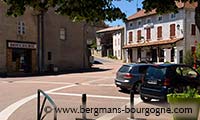
Compared to the other villages along the Côte d'Or Santenay has a slightly different atmosphere. The recently renovated village square, the Place du Jet d'Eau, gives it a bit more of a modern touch. The large square is surrounded by a pharmacy, a few winemaker's houses, a couple of restaurants and a wine shop.
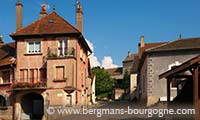
The village of Santenay consists of four parts – Santenay-le-Bas, Santenay-le-Haut, Saint-Jean and La Crée – spread out over the east- to south-facing slope below the Montagne des Trois Croix. Santenay-le-Bas, lower Santenay, is the main part of the village down by the railroad. Santenay-le-Haut, the oldest part part of Santenay which was called Narosse in the past, is another 500 metres up the slope, with La Crée just to the south. Just below the steep cliffs of the Montagne des Trois Croix you find Saint-Jean with its old church.
 The annual production of wine is 13 751 hl (1 833 466 bottles). This makes Santenay the fifth largest commune on the Côte in this respect. Only Meursault, Beaune, Savigny-lès-Beaune and Gevrey-Chambertin produce more.
In addition to this Santenay has gained fame thanks to the casino and the thermal springs. The health resort is currently closed for restoration, but the history of the springs rich in lithium goes back to Roman times. The first casino was opened in 1892. In 1914, when World War I broke out, the casino closed and was not opened until 1957.
The lower village was earlier known as a trade centre. With the arrival of the railway its position became even stronger. What is today known as the Place du Jet d'Eau was a covered market in the 17th century with three annual fairs and a weekly market. It survived until the middle of the 19th century when a fountain was built instead. It is also down here that you will find the most recent of Santenay's churches, the Notre Dame du Rosaire. The old church, in Saint-Jean, was considered a bit out of the way and there was a need for a church in the modern centre of Santenay.
© 2013 Ola Bergman